Invasion of
The Great Lakes
Sea Lamprey
Petromyzon marinus
Kelli Lightfoot
Kellil002@yahoo.com
|
Invasive species through out the United States have become an enormous problem for not only wildlife managers but for fisherman and whole ecosystems in general. Invasive species in the Great Lakes have been decimating native species at an alarming rate. The Sea Lamprey in particular have been killing off many native fish populations. Management, control, and education have helped to pacify the rate of population growth though their numbers are still increasing. |

April 27, 2006
Click here to return to student web pages.
Petromayzon Marinus
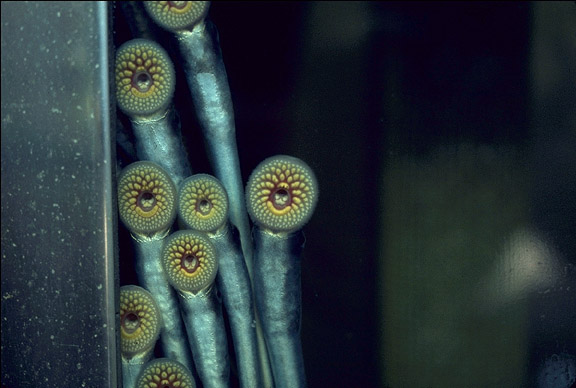
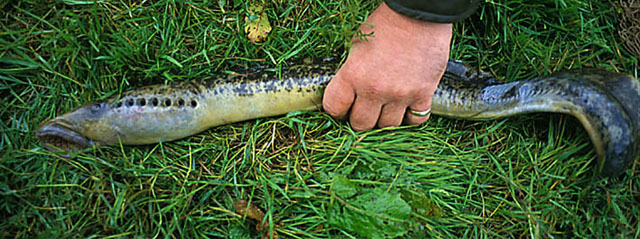
Fig 2. Lamprey mouths on glass (CORA,nd)
 Fig 3. Alien Invader (EPA, 2006) |
The EPA defines an invasive species as " an alien species whose introduction does or is likely to cause economic or environmental harm or harm to human health.(EPA,2006a)" Invasive species can have an extensive impact on ecosystems by depleting species' populations at many trophic levels. "Invasive species threat biodiversity, undermine the ecological integrity of many native habitats and push some rare species to the edge of extinction (Biodiversity, 2006)" They are also responsible for the harming of 42% of listed species protected by Federal Endangered Species Act. (Biodiversity, 2006) |
|
|
| Introduction of the
Sea Lamprey The Sea Lamprey is native to the Atlantic Coast which is how they were first introduced to the Great Lakes by traveling up through the man made Welland Canal. (See Fig 4) This canal was opened to bypass Niagara falls in 1829 once access to Lake Erie was established the sea lamprey could travel to the remaining 3 lakes. (Fuller et al,2006) The Sea Lamprey features look like an eel in its appearance but in fact is a jawless fish. Sea Lampreys have become such a large problem because they act as vampires of the sea, sucking out body fluids and blood from fish. To the dismay of fisheries, the sea lamprey's favorite fish is the Lake Trout. Along with over fishing by humans and water pollution, the sea lamprey has greatly reduced fish populations. Since communities of the Great Lakes rely on the fishing business, there has been a lot of work done to eradicate the sea lamprey. Lampricides and traps have been used to keep the sea lamprey population from completely exploding. However when the sea lamprey's killed off the large fish predators in the Great Lakes, the Alewife population was able to explode and create its own problems. There is a growing concern for the natural ecosystems of the Great Lakes and Lake Champlain not only because of the Sea Lamprey but also because of the impacts of other invasive species. |
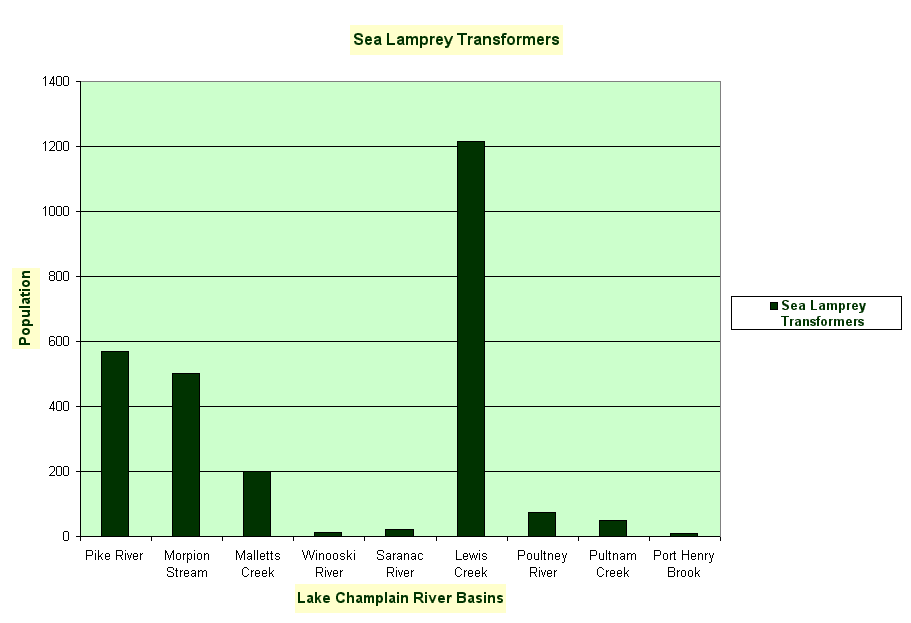
Fig. 5 Seal Lamprey Transformers in the Lake
Champlain River Basins (Marsden et al, 2004)
| Transformers are the juvenile sea lampreys that have not transformed
into their parasitic adult stage. Transformer populations are spread
through out the rivers of the Lake Champlain river basin though their
densities vary. (See Fig 5) It is important to monitor transformer populations to assess adult populations in the future. Since transformers can live up to 10 years in the river basins it can be difficult to get an accurate account of their numbers. |
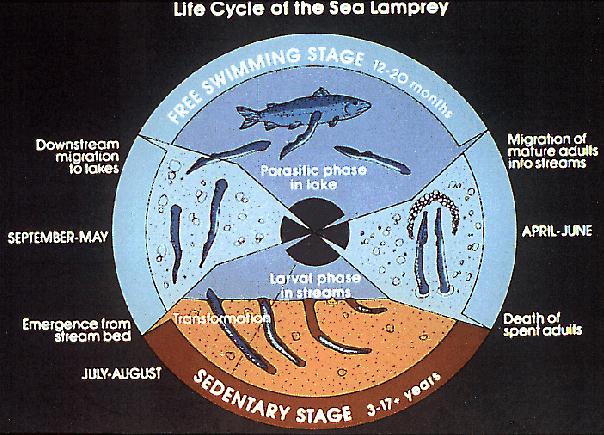 Fig 6.Lamprey Life Cycle (U.S. Fish & Wildlife Service, nd) |
Adult Sea Lampreys travel into connecting rivers to spawn. Once
a female has laid her 30,000 - 100,000 eggs, she and her mate die.
The fertilized eggs drift down stream where they will hatch in a few
weeks. Once the eggs hatch the larva will burrow into the river
bed where they can spend 2-10 years feeding on detritus and algae. After
their time as larva they will begin a process of transformation. During
this transformation time they will form eyes and a round disk of teeth. |
|
The Sea Lamprey is a cartilaginous jawless fish which means it's back is made up of cartilage instead of boney vertebrates. It has many gill openings that look like small holes. The most distinctive feature of the sea lamprey is its round mouth lined with many sharp curved teeth. Unlike what we commonly think of as a fish, the sea lamprey does not have a jaw that can open and close. This mouth is used to grasp onto a fish and hold on tight. Once it has grasped onto its prey it will extract blood and other body fluids. Survival of a sea lamprey attack is dependent on the size of the fish and the lamprey. While one fish may survive the initial attack, it can soon get and infection and die.
|
|
|
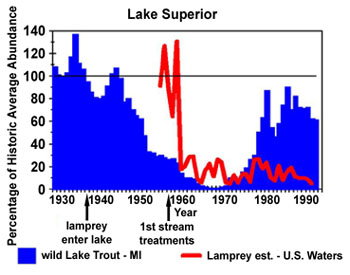
As seen in Fig 7, the introduction of sea lampreys was directly correlated with the drastic fall of wild Lake Trout populations in Lake Superior. When streams were treated for Lampreys, the wild Lake Trout populations were able to recover. The delay of recovery is a natural process that happens with population fall and rise. |
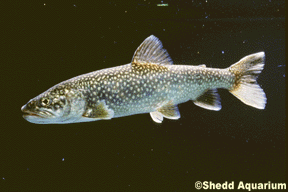 Fig.5 Lake Trout (Mikel, 2006) |
Lake Trout ,Salvelinus namaycush In 1936, lake trout fell from 3.4 million pounds in Lake Huron to almost extinction in 1947. In Lake Michigan, catch plummeted from 5.5 million pounds in 1946 to 402 pounds in 1953. Lake Superior's catch fell from 4.5 million pounds to 368 thousand pounds in 1961.See Fig 7.(Fuller et al ,2006) |
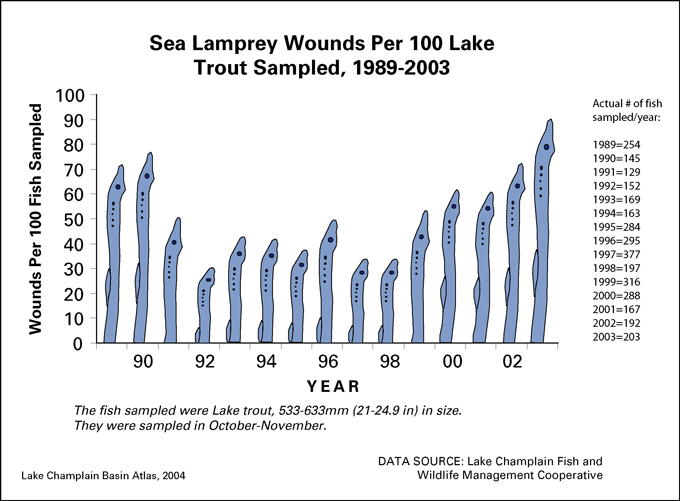
Fig 6.
Lake trout wounded in Lake Champlain (Lake, 2004)
| In 2005 it was reported that sea lampreys were in fact native to Lake Champlain, however sea lamprey populations have been rising and causing a lot of problems for Lake Champlain. Since 1998 there has been a steady increase in fish wounding rates due to sea lampreys. (See Fig 6 ) |
 |
Great Lake Invasive Species There are more than 140 aquatic nuisance species
identified in the Great Lakes Basin with 1 new organism being introduced each
year. The EPA has concluded that 10% of non native species of Great Lakes
have had significant economic and ecological impacts. Zebra mussels alone have
cost 120 million dollars between 1989-1994.(EPAb, 2006) It is estimated that the
U.S. economy spends 138 billion dollars a year on invasive species. |
|
|
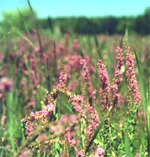
Purple Loosestrife Purple Loosestrife was first introduced in the 1980s on the East coast of the United States from Europe and Asia. Once here the Purple Loosestrife quickly spread along roads and drainage ditches. Because of its beauty the plant was harvested and distributed for ornamental purposes. This spreading has greatly assisted in the plants invasion. The problem with Purple Loosestrife is that its brushy thickness prevents native plants from growing under its shade as well inhibiting nesting for aquatic animals such as ducks, muskrats, toads, and bitterns. (GLIN, 2006) |
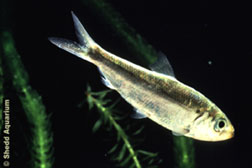 Fig.6 Alewife (Mikel,2006) |
Alewife, Alosa
pseudoharengus |
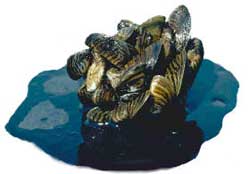 Zebra Mussels (EPAb, 2006) |
Zebra Mussel, Dreissena poymorpha Zebra Mussels are thumbnail size crustaceans that are native to the Caspian Sea by Asia. There were first discovered in 1988 in the Great Lakes. Their populations have since exploded. The problem with Zebra mussels is that they take over the lake floor covering native plants and animals as well as clogging intake pipes and navigation locks which has cost nearly 120 million dollars from 1989-1994. (EPAb, 2006) |
Land managers fight just to limit invasive species further spread; therefore control relies on understanding the species biology, the ecosystem it has infested, introduction pathways and effective tools, as well as follow through with monitoring.
|
Integrated Pest Management Uses biological, physical or mechanical, cultural, and chemical techniques as well as an assessment of risk, identification of thresholds for action, and planning to reach the most desired outcome. (USDA, 2006)
|
1. Prevention
|
|
|
The eradication of the Sea Lamprey began as early as the 1950's. Lampricide 3-trifluoromethyl-4-nitrophenol or also called more simply, TFM. This lampricide kills the juvenile lampreys in their river homes. Traps have also been used at the tributaries where the juveniles transform into adults and make their way to the lakes. (Fuller et al,2006) |
|
Establishment of Great Lakes Interagency Task Force and Promotion of a Regional Collaboration of National Significance for the Great Lakes
|
|
Invasive species Executive Order 131112 Directs federal agencies to use relevant programs and authorities to
|
|
Integrated Pest Management for the Sea Lamprey The Commission will provide an integrated sea lamprey management program that supports the Fish Community Objectives for each of the Great Lakes and that is ecologically and economically sound and socially acceptable. Milestones for Sea Lamprey Management
|
|
Click here for a letter to send addressing concerns with stricter regulations for hitch hiking invaders in North East waters.
|
|
|
Lake Champlain Basin Program
54 West Shore Road - Grand Isle, VT 05458
|
|
Representative Bernie Sanders (800) 339-9834 (toll free in Vermont)
|
Lake Champlain Basin Program 54 West Shore Road - Grand
Isle, VT 05458 |
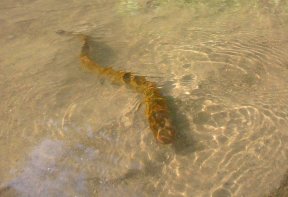
Click on the Eel to see a simulation swim!!
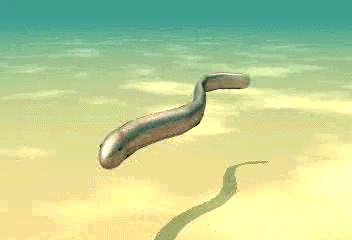
Swimming Lamprey Simulation (Lansner,
2002)
Links:
http://www.wcax.com/Global/SearchResults.asp?qu=sea+lamprey: Local WCAX news on the sea lamprey in local Vermont waters.
http://www.protectyourwaters.net/prevention/prevention_generic.php : Find ways to prevent further aquatic hitchhikers from invading our waters.
http://www.watershedcouncil.org/press68.html : President Bush's Budget Hangs the Great Lakes out to Dry
Biodiversity Parnership. 2006.Invasive Species. http://www.biodiversitypartners.org/invasive/index.shtml
Chippewa Ottawa Research Authority (CORA)Environmental Issues. http://www.1836cora.org/environmentalissues.html
Environmental Protection Agency (EPA).2004.Regional Collaboration: Interagency Task Force Executive Order http://www.epa.gov/greatlakes/collaboration/taskforce/eo.html
Environmental Protection Agency (EPA).2006a. Introduced Species. www.epa.gov/maia/html/intro-species.html
Environmental Protection Agency (EPA).2006b.
Fuller Pam,.Nico,Leo.,Maynard,Leao.2006.Petromyzon marinus.USGS Nonindigenous Aquatic Species Database,Gainesville,Fl.http:nas.er.usgs.gov/queries/factsheet.asp?speciesID=836> Retrieved on March 8,2006
Great Lakes Fishery Commission (GLFC) 1994.http://www.glfc.org/pubs/visimsl.htm
Great Lakes Information Network.(GLIN) 2006. Purple Loosestrife. http://www.great-lakes.net/envt/flora-fauna/invasive/loosestf.html
Jensen,Johnny.June 7, 2005.Petromyzon marinus.Nonindigenous Aquatic Species. http://nas.er.usgs.gov/queries/FactSheet.asp?speciesID=836.
Kolar,Cindy.2004.Technical Assistance Provided to the Great Lakes Fishery Commission for Lampricides. United States Geological Survey. www.umesc.usgs.gov/invasive_species/sea_lamprey/tech._assistance.html .Retrieved on March 8, 2006.
Lake Champlain fish and wildlife managament cooperative. (Lake)2004. www.lcbp.org/atlas/html/is_lampreyfig.htm
Lansner, Anders. 2002. Autonomous Walker and Swimming Eel. http://www.ip-atlas.com/pub/nap/
Lifesaver.nd.http://www.inmagine.com/pdil095/pdil095041-photo
Marsden,Ellen J., Eric Howe, Patrick Sullivan, Mark Malchoff.2004. Great Lakes Fishery Commision. Project Completion Report. "Movement and Population Size of Sea Lamprey in Lake Champlain and its Tributaries. February 16, 2006.
Mikel,Gina.2002.SeaLamprey.February 9, 2006. www.seagrant.wisc.edu/greatlakesfish/sealamprey.html.
Sohn, E.2005. Smelly Traps for Lampreys. http://www.sciencenewsforkids.org/articles/20051116/Note2.asp
United States Geological Survey.USGS.2006.Retrieved on
USDA Forest Service Authorites. 2006. Invasive species. http://www.fs.fed.us/invasivespecies/policy.shtml
U.S. Fish and Wildlife Service.nd. Sea Lamprey Life Cycle. http://www.fws.gov/midwest/Marquette/cycle.html